


The exceptional reputation of the Swoosh trademark recognized by the EUIPO


In a decision dated October 20, 2025, the EUIPO upheld an opposition filed by the company that owns the NIKE trademarks , in particular the figurative trademark representing the Swoosh, against European Union trademark application No. 18 992 624 “RANE SPORTS.”
The opposition was based on earlier EU trademark No. 4 288 486 and Articles 8(1)(b) and 8(5) of the EUTMR.
The Office first recognized the reputation of Nike’s figurative “Swoosh” trademark within the meaning of Article 8(5) of the EUTMR, in view of the numerous proofs of long-standing, intensive, and widely recognized use. NIKE regularly ranks among the most valuable trademarks in the world:
- Interbrand placing it 9th position in 2023,
- Brand Finance listing it in the top 100,
- Kantar BrandZ ranking it as the most valuable apparel brand in 2022.
The examiners noted that the Swoosh trademark is highly visible in many major advertising campaigns and also enjoys a constant and significant presence on social media. Its visibility is enhanced by its partnerships with world-renowned athletes and its role as an equipment supplier to clubs and national teams in Europe.
In addition, the figurative mark is recognized by the European media, which confirms that the Swoosh mark is recognizable even without the word mark NIKE.
The Office also pointed out that several decisions by the EUIPO and national authorities have already recognized the reputation of the Swoosh, confirming its current, strong reputation, which is supported by numerous independent sources.
The Office concluded that all the evidence provided by the trademark owner “confirm that the Swoosh trademark is widely known, highly regarded, and strongly associated with quality, innovation, and athletic achievement for at least clothing, footwear, headgear. The evidence demonstrates a very strong reputation that is current, geographically relevant, and supported by independent sources “.
On comparing the signs, the EUIPO found a slight visual similarity: although they share the idea of a common curved shape, the signs are distinguished by their orientation, the angularity of their curve, and the addition of the word elements “RANE SPORTS” in the second sign.
Conceptually, the signs were deemed dissimilar: the contested sign refers to sporting activities, while the Swoosh figurative sign has no particular meaning.
However, given the exceptional reputation of the earlier trademark and the identity of the products, even in the presence of a low degree of similarity between the signs, the European Office found that “The mark’s figurative element has become an iconic symbol immediately associated with the opponent’s brand. Given the very strong reputation of the earlier mark and identity of the goods, even a low degree of visual similarity between the signs may be sufficient to trigger in the mind of the relevant public an association with the reputed mark”.
In view of these factors, the Office considered that the use of the sign contested by its applicant would consist in taking unfair advantage of the distinctive character and reputation of the Swoosh figurative mark.
Opposition No. B 3 218 761, EUIPO, Decision of October 20, 2025
Statute of limitations for copyright infringement proceedings: single act or separate acts, a decisive distinction
In a decision handed down on 3 September 2025 and published in the Bulletin (Cass. 1st civ., 3 Sept. 2025, no. 23-18.669), the Court of Cassation clarified the rules governing the limitation period applicable to copyright infringement actions, based on Article 2224 of the Civil Code.
In this case, on 6 June 2018, the authors, composers and co-publishers of a musical work entitled ‘Un monde sans danger’ brought an action for copyright infringement against The Black Eyed Peas. They accused the group of copying their work in the song ‘Whenever’ from the album ‘The Beginning’ released in 2010.
In a decision dated 17 May 2023, the Paris Court of appeal dismissed their claim on the grounds that the action brought in 2018 was statute-barred, as personal or movable property actions must be brought within five years from the date the claimant became aware of the relevant facts. The judges held that the disputed title had been marketed worldwide since 2010, so that the claimants must have been aware of it from that date onwards, especially since they had sent a formal notice to the group in 2011. Therefore, having brought the case before the court eight years after becoming aware of the facts, the claimants had acted outside the limitation period, resulting in the dismissal of their claim.
The Court of Cassation overturned the Court of appeal’s ruling that the action was statute-barred, noting that it had failed to take into account several acts of distribution that occurred within five years prior to the claim. The Court further emphasized that the limitation period must be assessed on an act-by-act basis, as each act constitutes a separate infringement.
It stated that ‘when the infringement results from a series of separate acts, whether acts of reproduction, performance or distribution, and not from a single act of this nature that has continued over time, the limitation period runs for each of these acts from the day on which the author became aware of such an act or should have become aware of it’.
This solution aims to distinguish between a single act of infringement that continues over time (e.g. the continuous online publication of a work) and a series of separate acts (e.g. repeated reproductions or distributions). In the first case, the five-year limitation period runs from the date on which the single act became known, while in the second case, it runs for each act from the date on which it became known.
The Paris Judicial Court, in a judgment of 18 September 2025 (TJ Paris, 3rd ch. 1st sect., 18 Sept. 2025, No. 21/11565), applied the position of the Court of Cassation. It examined the limitation period for each alleged act of infringement (use of photographs on album covers and distribution of a video clip), finding that the acts in question constituted single acts of reproduction and distribution that continued over time, without renewal. The Court held that the claimant knew or should have known of the disputed acts no later than the signing of a settlement agreement in July 2015, so that the five-year limitation period had expired by the time the claim was filed in September 2021. The actions were therefore dismissed as statute barred.
These decisions illustrate the strictness of the assessment of the starting point of the limitation period in copyright infringement cases and the need for rights holders to act diligently as soon as they become aware of the disputed acts.
Cass. 1re civ., 3 sept. 2025, n° 23-18.669
TJ Paris, 3e ch. 1re sect., 18 sept. 2025, n° 21/11565
Appeal against a French patent opposition decision: clarification on the inadmissibility of auxiliary requests filed for the first time on appeal
In its decision dated September 26, 2025, the Paris Court of Appeal provides an important clarification regarding the admissibility of auxiliary requests submitted for the first time on appeal in the context of an appeal filed against an INPI decision issued in opposition proceedings.
The Court confirms that these requests remain inadmissible, even when the opponent introduces new prior art at the appeal stage.
Background of the case:
The case concerns French patent No. FR 3072109, relating to a fencing system, owned by the company Arcal (hereinafter “Arcal”).
Filed on October 6, 2017, and granted on December 4, 2020, the patent was opposed on September 3, 2021, by the company Océane Profils (hereinafter “Océane Profils”).
In a decision dated March 9, 2023, the Director General of the INPI ruled that the opposition was partially well-founded and maintained the patent in amended form.
Océane Profils filed an appeal against this decision.
Before the Court of appeal, it submitted several new prior-art documents, including document “D16”.
In response, Arcal filed new auxiliary requests intended to address these additional documents.
Nature of the appeal:
Firstly, the Court of appeal recalls that an appeal against an INPI decision ruling on an opposition to a French patent is an appeal for reformation (Article R. 411-19, paragraph 2 of the French IP Code), which gives the Court full jurisdiction over the dispute.
In the present case, Océane Profils requested the annulment of the INPI decision. Arcal argued that this request should be declared inadmissible.
The Court dismisses the application for inadmissibility and notes that the request made by Océane Profils cannot be understood as relying on any legal ground capable of justifying the annulment of the INPI decision.
No other distinct ground for nullity was invoked.
Therefore, the Court considers that the request can only be understood as seeking the reformation of the Director General’s decision.
The Court further emphasizes that the error in the wording of the submissions, referring to “annulment” instead of “reformation”, does not affect the admissibility of the appeal.
Examination of new prior art:
When examining the prior art filed for the first time on appeal by Océane Profils, the Court rules that these documents, and in particular document “D16”, deprive claim 1 of inventive step.
For the first time, the Court reforms an INPI opposition decision based on new prior art introduced only on appeal.
Inadmissibility of auxiliary requests:
However, the Court refuses to recognize the possibility for the patentee to amend its claims in response to these newly filed documents.
To reach this conclusion, the Court restates the distinction between “new grounds” (which are admissible on appeal) and “new claims” (which are not).
It concludes that auxiliary requests filed for the first time on appeal constitute new claims.
Under Article R. 411-38 paragraph 2 of the French IP Code, such claims are inadmissible.
The new auxiliary requests filed by Arcal must therefore be rejected.
Consequently, the appeal may lead to a reformation of the INPI decision based on new prior art (“new grounds”), while the patentee is prohibited from modifying the claims through new auxiliary requests (“new claims”), as these would alter the scope of protection sought.
Jurisprudential context:
This decision is consistent with several earlier rulings issued by the Paris Court of Appeal in 2025:
- April 9, 2025, RG No. 23/14096: the Court declared inadmissible auxiliary requests newly submitted on appeal, in a case where no new prior art had been introduced on appeal;
- July 4, 2025, RG No. 23/16553: the Court similarly dismissed auxiliary requests submitted for the first time on appeal, intended to amend the patent claims for the first time on appeal, holding that they constituted inadmissible new claims.
This decision of September 2026, 2025, therefore, provides a decisive clarification: even when the opponent files new prior art, the patentee is not allowed to amend its claims on appeal.
Thus, the appeal for reformation cannot be used as an opportunity to rewrite the patent, a process that remains strictly confined to the administrative proceedings before the INPI.
It will be interesting to see whether this position, which is very unfavorable to patentees and may encourage strategic behavior in opposition proceedings, will be submitted to the Court of cassation.
Paris Court of Appeal, September 26th, 2025, No. 23/06726
Street art and television documentary: the Paris Judicial Court sanctions the unauthorized reproduction of a work in a reconstruction of Professor Raoult’s office in a television report
In this case, a graffiti artist sued Diversité TV France, Nextinteractive, TV Presse Productions, and Slug News Network for having, without her authorization, reproduced and displayed her work “Exegi Monumentum Aere Perennius” in a report broadcast on RMC Story entitled “The Hidden Side of Didier Raoult: The Inside Story of an Incredible Controversy” as part of a reconstruction of Professor Raoult’s office. The artist claimed that her economic and moral rights, as well as her reputation, had been infringed, and sought injunctive relief, withdrawal, destruction, judicial publication, and damages.
On the merits, the Court recalled that the reproduction and representation of a work without authorization is unlawful (Articles L.122-4 et seq. of the Intellectual Property Code). It then rejected the accessory theory, which allows, under certain conditions, the reproduction or representation of a protected work without the author’s authorization when that work appears in a secondary, “accessory” manner in relation to the main subject of a new creation, as well as the exception for current information, as the reproduction was neither essential nor proportionate to the aim pursued.
The Court also found an infringement of the author’s moral rights, as the artist’s signature had been reproduced on the copy of the work without authorization and her name had not been mentioned during the broadcast.
However, it rejected the claim of infringement of the integrity of the work and of reputation, as no direct criticism had been made of the work itself.
The Court ordered the defendant companies to pay the artist damages for the infringement of her economic and moral rights. In addition, it ordered the removal of the disputed sequences from the report, the destruction of the copy of the work, and prohibited any use of the work or its copy without mentioning the author’s name.
This decision highlights the strict scrutiny exercised by the courts over exceptions to the author’s exclusive exploitation rights, including the accessory doctrine and the exception for current information, which are interpreted narrowly. It also underscores the importance of respecting moral rights, notably the right of attribution, even in audiovisual works produced for informational purposes.
TJ Paris, 3e ch. 3e sect., 10 sept. 2025, n° 23-07780
Libertino/Liberto: trademark infringement upheld, unfair and parasitic competition dismissed
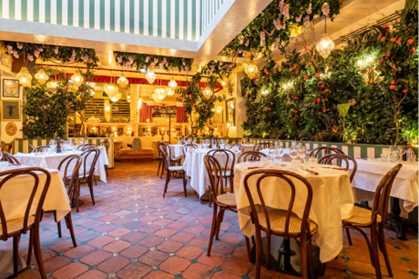

On October 8, 2025, the Paris Court of Justice ruled on a dispute between the Big Mamma group, operator of the Parisian restaurant “Liberto,” and a company belonging to the Food Affairs group, having launched an Italian restaurant named “Liberto.” Considering that there was a likelihood of confusion between the two brands, Big Mamma and Libertino sued the company operating the “Liberto” restaurant on the grounds of infringement of the French and European trademarks “Libertino,” unfair competition, and parasitism, claiming that the company had adopted their visual identity and thus unduly sought to profit from their reputation.
Regarding trademark infringement, the Court rejected the defense’s argument that “Liberto” was not used as a trademark and found that this sign was perceived by the public as indicating the origin of the restaurant services. Observing the strong visual, phonetic, and conceptual similarities, the judges ruled that trademark infringement by imitation was established.
Concerning unfair competition, the plaintiffs alleged the wrongful use of their decorative style consisting of a “combination of walls covered with hundreds of illuminated bottles of alcohol, a luminous plant ceiling, and a floral and plant-inspired decor” by a restaurant targeting the same clientele and located nearby. The Court dismissed the plaintiffs’ claims on the grounds that they failed to demonstrate the existence of a specific visual identity or its notoriety, especially since some decorative elements are not used in all of their establishments. The judges also pointed out that the alleged floral and plant-based style is common in Parisian restaurants, which means that it cannot be appropriated by an operator without breaching freedom of trade.
Finally, the Court dismissed the claim of parasitism, as Big Mamma and Libertino failed to demonstrate that their visual identity was the result of specific investments generating an individualized economic value. The alleged appropriation of their business model, based on a concept of young and friendly Italian restaurants promoting fresh produce, does not constitute parasitism either, as it is a simple idea that cannot be monopolized.
This decision is not yet final and may be subject to appeal.
TJ Paris, 3rd Chamber, 3rd Section, October 8, 2025, No. 23/06665
Reuse of a tie-dye pattern: imitation is not always at fault
A high-end ready-to-wear fashion house sued the Mango group for unfair competition and parasitism, accusing it of reproducing a tie-dye fabric in gray and lilac in March 2020 and using it on four items in its collection (two dresses, a skirt, and a blouse).
In its ruling of September 10, 2025, the Versailles Court of appeal upheld the dismissal of the claims : it emphasized that the patterns at stake belonged to a common fashion fund and that there was no risk of confusion between the pieces concerned.
On the basis of unfair competition, the Court recalled that “simple imitation is not sufficient to demonstrate the risk of confusion,” as this risk of confusion must be characterized by the plaintiff in order to establish faulty practice. In this case, the Court dismissed the claim of unfair competition and considered that the appellant had failed to prove the risk of confusion alleged.
The Court highlighted several factual elements to dismiss this likelihood of confusion: the fact that the products were not marketed at the same time, the non-iconic nature of the motif at issue, the fact that the motif was part of the common fashion repertoire, the general trendiness of the items, and the difference in positioning between the two brands, one being high-end and the other mass-market.
Finally, regarding parasitism, the Court found that the appellant company had also failed to establish the individualized economic value associated with the pieces claimed. The alleged investments were not directly related to the clothing concerned, the advertisements and sales figures did not prove that promotional efforts had been made specifically for these motifs, and the items involved had not been renewed beyond the spring-summer 2021 season. Consequently, the individualized economic value of these clothing items with “tie-dye” patterns was not demonstrated by the appellant company.
Versailles Court of Appeal, Commercial Chamber 3 1, September 10, 2025, No. 23/05890

See also...
Newsletter employment law – july 2026
Published on 24 July 2026 at 16h20
IP STARS: The Intellectual Property Team Recognized in 2026
Published on 01 July 2026 at 13h35
Newsletter Intellectual property – june 2026
Published on 25 June 2026 at 12h56